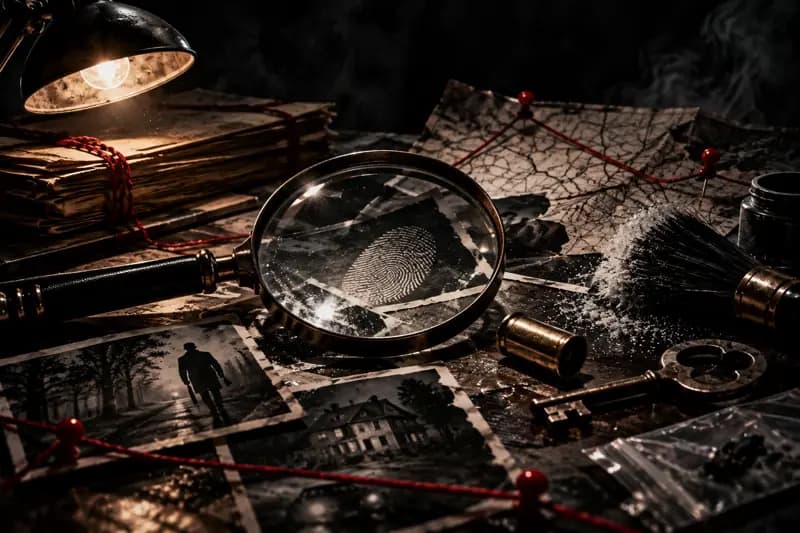
If you watch crime dramas, you have probably heard it: every contact leaves a trace. It is the idea behind a great deal of forensic work, from a single fiber on a sweater to a smear of dirt on a boot. It is named after a French investigator, Edmond Locard.
This article explains what the principle says, who Locard was, how investigators use it, and where it stops being useful. It also corrects a small myth: the famous short version is not a direct quote from Locard.
The principle in one sentence
The exchange principle says that when two objects come into contact, material is transferred between them. A burglar who climbs through a window may leave fibers from their clothing on the frame and take glass fragments or dust away on their shoes. The traces are often tiny and often invisible, but they exist.
An official forensic guideline, published by the Scientific Working Group on Materials Analysis (SWGMAT) and hosted by the U.S. National Institute of Standards and Technology, puts it plainly: "Locard's Exchange Principle states that whenever two objects come into contact, a transfer of material will occur." The same document adds that transferred trace evidence "can be used to associate objects, individuals, or locations."
The logic runs in reverse from what you might expect. The investigator does not see the contact; they find the transferred material and conclude that the two things were, at some point, together.
Who was Edmond Locard?
Edmond Locard (1877–1966) was a French criminologist who worked in Lyon. He studied medicine and law and became an assistant to Alexandre Lacassagne, a leading figure in French forensic medicine. In 1910, he persuaded the Lyon police to give him space for a laboratory, usually described as two attic rooms and a couple of assistants. It is widely regarded as the world's first police crime laboratory.
According to a reference article from EBSCO, Locard was inspired by Arthur Conan Doyle's Sherlock Holmes stories, and by the work of the French police scientist Alphonse Bertillon and the Austrian criminologist Hans Gross. His nickname, "the Sherlock Holmes of France," stuck.
Over his career Locard wrote many books and articles, including a long work in several volumes, the Traité de criminalistique, published in the 1930s. He also wrote on the study of dust: essays on dust analysis appeared in English-language police journals in 1928 and 1930. He called the tiny particles that cling to people and clothing "mute witnesses, sure and faithful, of all our movements and all our encounters."
Reference works also credit him with wartime work. During the First World War, according to a Gale reference entry, he was able to work out where soldiers and prisoners had died by examining the stains on their uniforms.
The quote that Locard didn't quite write
Here is the wrinkle. "Every contact leaves a trace" is how the principle is usually summed up, and many sources attribute those exact words to Locard. The same reference sources say it is a later summary.
A Gale reference entry notes that Locard's publications make no mention of an "exchange principle." What he did write, in French, is this:
Il est impossible au malfaiteur d'agir avec l'intensité que suppose l'action criminelle sans laisser des traces de son passage.
In English: it is impossible for a criminal to act with the intensity that a criminal act involves without leaving traces of their passage. The same entry says the term "principle of exchange" first appears in a 1940 book, Police and Crime-Detection, and was adapted from Locard's observations.
So the idea is Locard's, the short slogan is a summary, and the name "exchange principle" came from later writers. None of this weakens the principle. It just means that if you are quoting Locard, the French sentence above is the safer one to use. We could not check the French original of the Traité directly, so we rely on the reference entry for the wording.
How the principle is used in practice
The principle shapes how investigators work at a scene and in the laboratory.
- At the scene. Investigators assume that a scene may hold traces from the offender, and that the offender may have carried traces away. They protect the scene and enter by one path so as not to add their own traces. (Our article on what happens at a crime scene covers these steps.)
- In collection. The NIJ's crime scene guide says to use protective equipment, to change or clean tools between items, and to consider collecting elimination samples from first responders, so that their traces can be told apart from the traces that matter.
- In the laboratory. Examiners compare recovered material with known samples. Sources list hair, fibers, dirt and blood among the common kinds of trace evidence. Fingerprints are one visible form of the same idea; our article on how fingerprint evidence works explains how those are compared.
A famous case, told with caution
Popular accounts of Locard often tell the story of a 1912 murder case in Lyon. A young woman, Marie Latelle, was found dead, and a suspect, Émile Gourbin, had what looked like a solid alibi. In the version usually told, Locard examined scrapings from under Gourbin's fingernails and found traces of a pink face powder, and a Lyon druggist was said to have made that powder for the victim. Faced with this, Gourbin confessed.
This case appears in many popular histories, but the details differ from one telling to the next (including the exact composition of the powder and how the alibi unraveled). The sources we found are blogs and educational websites rather than archival records, so treat the story as an illustration of the idea and not as a verified account.
The limits of the principle
Locard's idea is powerful, but it can be misunderstood in both directions.
1. Transfer does not guarantee recovery. The principle says that transfer happens. It does not promise that investigators will find the material. Traces can be lost soon after they land: they fall off, are brushed away, washed off or swamped by other material. The SWGMAT guideline says that an understanding of how trace evidence transfers and persists helps the examiner interpret the significance of the results. In plain terms: failing to find a trace is not proof that there was no contact.
2. A trace has to be explained. Finding a fiber from a person's sweater in a room does not show a crime took place. They might live there, or visit often. The EBSCO article notes that the evidential value of exchanged material depends on there being no acceptable alternative explanation for why it is where it is.
3. Contamination can create false traces. Investigators, medics, police and even the people at the scene can add or move material. That is why scenes are controlled, and why records of who entered and what was collected matter. The SWGMAT guideline asks examiners to prevent "contamination and loss" and to wear protective clothing that is changed as needed to avoid transfer between items.
4. It tells you about contact, not intent. A trace shows that two things touched. It does not, by itself, show who was responsible or why.
Beyond physical evidence
The EBSCO article adds that the principle is sometimes applied by analogy to digital forensics, where computers that communicate with one another leave traces on each other. The physical principle is the original; the digital version is a way of thinking, not a law of nature.
Myths and facts
| Myth | Fact |
|---|---|
| Locard wrote "every contact leaves a trace." | The slogan is a later summary. Locard wrote a longer French sentence about criminals leaving traces of their passage. |
| Every crime scene yields trace evidence. | Transfer happens, but traces can be lost or too small to find. |
| Trace evidence proves who committed a crime. | It shows contact between objects or places. What the contact means needs other evidence. |
| Only offenders leave traces. | Everyone who enters a scene can leave or move traces, including police and medical staff. |
Frequently asked questions
Is Locard's principle a law of physics?
No. It is a guiding idea of forensic science, not a mathematical law. It tells investigators where to look, not what they will find.
What counts as trace evidence?
Small amounts of material transferred between people, objects and places: hair, fibers, soil and dust, glass, paint and similar substances. The category is defined by the size and kind of material and not by a single type.
Did Locard invent fingerprinting?
No. Fingerprints were already being studied and used by the time Locard worked. Wikipedia notes that he was the first to codify the "Galton points" used in fingerprint identification, but he is best remembered for his laboratory and for his work on trace evidence.
Does the principle apply to DNA?
DNA is one kind of material that can be transferred, and the principle applies to it as it does to other traces. The EBSCO article notes that as technology advances, the scale of the material examined is expected to keep shrinking, which is one more reason contamination control matters.
Where the app fits in
The Evidence & Clues collection in the True Crime Coloring Book app is full of the objects this article talks about: evidence tags, envelopes, fingerprint cards and magnifying glasses on a desk. You choose the colors, and the artwork stays illustrative rather than graphic.
Sources
- Scientific Working Group on Materials Analysis (SWGMAT), Trace Evidence Recovery Guidelines, 1998, hosted by the National Institute of Standards and Technology: the statement of Locard's exchange principle, and guidance on contamination and loss.
- Gale, Locard's Exchange Principle, World of Forensic Science, via Encyclopedia.com: Locard's French sentence, the 1940 origin of the term "principle of exchange," and his First World War work.
- Edward Johnson, Locard's exchange principle, EBSCO Research Starters, 2020: background on Locard, the "mute witnesses" quotation, types of trace evidence and limits of interpretation.
- Laura Spinney, Long-lost photos reveal details of world's first police crime lab, Nature, April 2024: the Lyon laboratory founded in 1910.
- Edmond Locard, Wikipedia, for his dates, training and the Lyon laboratory's beginnings.
- National Forensic Science Technology Center for the National Institute of Justice, Crime Scene Investigation: A Guide for Law Enforcement, 2013: contamination control and elimination samples.
- Popular accounts of the 1912 Lyon case (educational and history websites). These are not archival sources, and details vary between them.