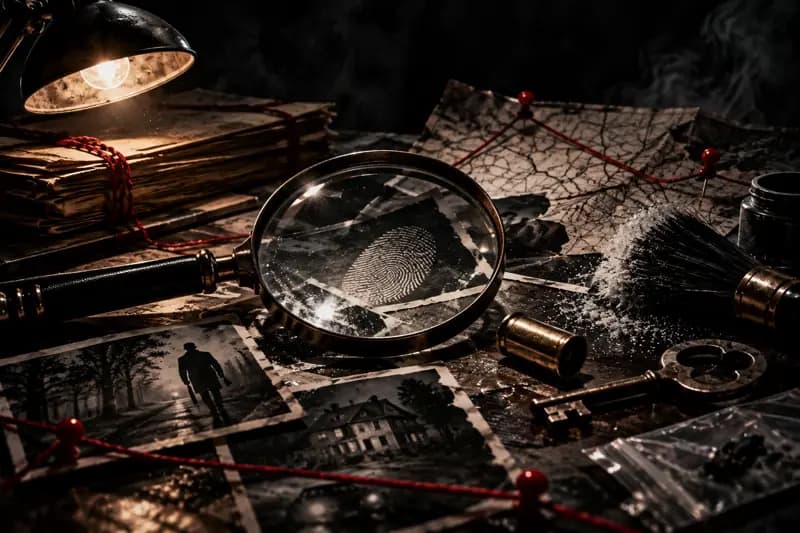
For more than a century, a fingerprint on a window, a cup or a sealed envelope has been one of the most trusted pieces of evidence in a criminal case. It can place a person at a scene, tie two crimes together or clear an innocent suspect.
It is also more fallible than television suggests. This article explains how fingerprints form, how examiners compare them, what research says about mistakes, and what one famous error teaches us.
What a fingerprint actually is
A fingerprint is the pattern of tiny raised lines on the skin of your fingertips, called friction ridges. They form during fetal development, around the 15th week, and the pattern is essentially set before birth. Genes influence the general type of pattern, while small differences in the environment inside the womb make each individual print different. That is why even identical twins do not share the same fingerprints.
Examiners describe prints on two levels:
- Overall pattern. Most prints fall into one of three types: arches, where ridges enter on one side, rise in the middle and exit on the other; loops, where ridges enter and leave on the same side; and whorls, where ridges circle around a central point. Loops are by far the most common and arches the rarest.
- Fine detail. Inside the pattern are small features called minutiae, such as a ridge that ends or one that splits in two (a bifurcation). The arrangement of these details is what examiners compare.
The ridges stay in place for life, though injury, aging and some medical conditions can change or damage them.
The three kinds of prints at a scene
Investigators distinguish between prints by how they were left:
| Type | What it is | Example |
|---|---|---|
| Patent | Clearly visible without any treatment | A print left in ink, paint or blood |
| Latent | Invisible, usually a partial print left by natural oils and sweat | A print on a glass or a doorknob |
| Plastic | A three-dimensional impression | A print pressed into soap, putty or wax |
Latent prints, the most common kind, have to be made visible first. Examiners may brush them with a fine powder, expose the surface to cyanoacrylate (superglue) fumes, or treat paper with chemicals such as ninhydrin. The developed print is then photographed or lifted so it can be compared.
How examiners compare prints
In most laboratories the work follows a framework known as ACE-V, which stands for Analysis, Comparison, Evaluation and Verification:
- Analysis. The examiner studies the unknown print, called the latent, and decides whether it contains enough detail to be useful.
- Comparison. The latent is compared side by side with a known print, for example from a suspect or from a database search.
- Evaluation. The examiner reaches one of three conclusions: identification (the same source), exclusion (a different source) or inconclusive.
- Verification. A second examiner reviews the result.
Computer systems can search very large collections of records and suggest likely candidates, but the final comparison is made by a trained person, which is why human judgment matters so much.
A short history
- 1880. Scottish physician Henry Faulds, working in Japan, publishes a paper in Nature proposing that fingerprints can be used to identify people.
- 1892. Francis Galton publishes Finger Prints, a classification study that helped establish fingerprints as a basis for identification. In the same year in Argentina, police official Juan Vucetich creates one of the first systems for filing fingerprint records.
- 1897. A fingerprint bureau opens in Calcutta (now Kolkata), India, using a classification system later associated with Edward Henry and developed with Azizul Haque and Hem Chandra Bose.
- 1901. Scotland Yard begins fingerprinting individuals, and fingerprint evidence soon appears in courtrooms.
By the early twentieth century the method had spread to police forces around the world, long before anyone had measured how often examiners make mistakes.
How reliable is it?
That question was studied seriously only in the last two decades, and the answer is more nuanced than "fingerprints never lie."
The FBI black-box study. In 2011, researchers from the FBI laboratory and a partner organization published the largest study of its kind in the Proceedings of the National Academy of Sciences. 169 examiners each compared about 100 pairs of prints, producing 17,121 decisions. The study found a false positive rate of 0.1%, meaning examiners wrongly declared a match about once in a thousand comparisons of prints from different people. The false negative rate, where examiners missed a true match, was much higher at 7.5%. The authors also found that independent verification by a second examiner would have caught all of the false positives in the study. Inconclusive results were not counted as errors.
The 2009 National Research Council report. An influential review, Strengthening Forensic Science in the United States: A Path Forward, called for stronger scientific validation across several forensic disciplines. In fingerprint work, later commentary on the report noted that ACE-V is a broad framework rather than a precisely defined method, and that the final judgment is left largely to the examiner, which makes it hard to guarantee that two examiners will reach the same result.
The 2016 PCAST report. The President's Council of Advisors on Science and Technology concluded that latent print analysis is foundationally valid, meaning it rests on a sound basis. It also said the false positive rate is substantial and may be higher than many jurors would assume, citing an upper estimate of roughly 1 error in 306 comparisons. Forensic practitioners have disputed how PCAST calculated its figures, noting that laboratories normally use independent verification.
The fair summary: fingerprint comparison is a genuinely useful tool with a low but real error rate, and it works best when examiners verify each other's work independently. "No two people have the same fingerprints" is a different claim from "no examiner ever makes a mistake."
When it fails: the Brandon Mayfield case
On March 11, 2004, bombs on commuter trains in Madrid killed nearly two hundred people. Spanish police found a partial fingerprint on a bag of detonators and shared it with the FBI. FBI examiners matched it to Brandon Mayfield, a lawyer in Oregon, and he was arrested in May 2004 as a material witness.
He had nothing to do with the attack. The Spanish authorities disagreed with the match and identified a different person as the source of the print, and the FBI withdrew its identification. Mayfield was released after a few weeks, and the FBI publicly apologized to him.
In January 2006 the Justice Department's Inspector General examined what went wrong. The report found errors in the way the print was examined. The two prints were unusually similar, but examiners were overconfident despite differences between them, and the verification step was not truly independent, because the examiners who reviewed the match already knew that a colleague had declared it. The report also concluded that examiners were probably more resistant to re-examining their conclusion because of Mayfield's religion.
The case became a standard lesson in forensic science. It showed that a similar-looking print is not the same as a matching print, and that confirming someone else's answer is not the same as checking it from scratch.
Fingerprint myths and facts
| Myth | Fact |
|---|---|
| Every crime scene has usable fingerprints. | Many surfaces leave no usable print, and partial or smudged prints are common. |
| A fingerprint match is 100% certain. | Examiners can and do make errors, which is why verification matters. |
| Identical twins have identical prints. | Even identical twins, who share nearly the same DNA, have different fingerprints. |
| Fingerprints never change. | The ridge pattern is stable, but injury, age and some conditions can alter it. |
Frequently asked questions
Can two people have the same fingerprint?
No case of two people with identical complete fingerprints has been documented. The practical question is different: whether a partial, smudged print from a scene can be reliably matched, which is where errors happen.
Is a fingerprint match proof of guilt?
A match shows that a person's finger touched a surface. It does not show when, or why. Fingerprint evidence is one piece of a larger case.
How long do fingerprints last at a scene?
It depends on the surface, the conditions and how the print was left. A print on a clean, dry, smooth surface can survive far longer than one on a rough or wet surface, so there is no single answer.
Where the app fits in
The Evidence & Clues collection in the True Crime Coloring Book app is built around exactly these objects: fingerprint cards, evidence tags, envelopes and magnifying glasses on a desk. You pick the colors, and the artwork stays illustrative rather than graphic.
Sources
- B. T. Ulery, R. A. Hicklin, J. Buscaglia and M. A. Roberts, Accuracy and reliability of forensic latent fingerprint decisions, Proceedings of the National Academy of Sciences, 2011.
- National Research Council, Strengthening Forensic Science in the United States: A Path Forward, National Academies Press, 2009; C. Champod, Fingerprint identification: advances since the 2009 National Research Council report, 2015.
- President's Council of Advisors on Science and Technology, Forensic Science in Criminal Courts: Ensuring Scientific Validity of Feature-Comparison Methods, 2016.
- NBC News, FBI just sloppy in bomb mistake, inquiry finds, January 2006, summarizing the U.S. Department of Justice Inspector General's report on the Brandon Mayfield case.
- Fingerprint, Wikipedia, for background on ridge formation, print types and early history.