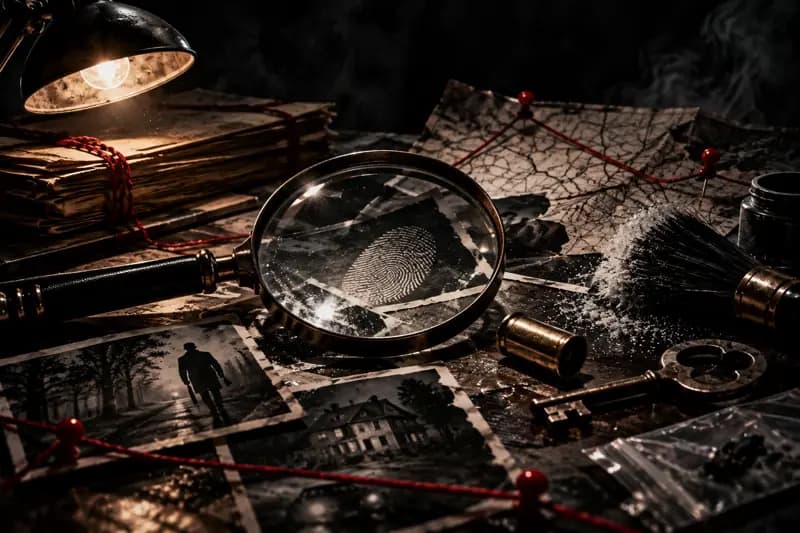
A knife on a kitchen floor is just a knife. A knife in a sealed envelope, with a number on it, initials across the tape and a signed list of everyone who has held it since, is evidence. The paperwork is not a formality. It is what lets a court believe that the object it is looking at is the one that was found at the scene.
That paperwork trail is called the chain of custody. This article explains what it is, what it records, how it is built step by step, and what it means when the chain has a gap. It describes general U.S. practice and official guidance, not any one agency's rules, and it is not legal advice.
The definition
The National Institute of Justice (NIJ) crime scene guide defines it in one sentence: chain of custody is "a process used to maintain and document the chronological history of the evidence."
The same entry lists what the record should contain: the name or initials of the person who collected the item, each person or entity that later had custody of it, the dates it was collected or transferred, the agency and case number, the victim's or suspect's name, and a brief description of the item.
Put simply, it answers four questions about any object, at every moment from the scene to the courtroom: what is it, who has it, since when, and where has it been?
Why it matters
Evidence only helps if it can be shown to be what it is claimed to be. The Federal Rules of Evidence put it this way in Rule 901(a): the party offering an item must produce evidence "sufficient to support a finding that the item is what the proponent claims it is."
Notice that the phrase "chain of custody" does not appear in Rules 901 or 902. It is a name for a practical way of meeting the requirement. The rule's advisory notes also observe, citing the legal scholar Wigmore, that no special rules have been developed for authenticating physical objects.
There are two reasons the record matters:
- Identity. Was this the bag found next to the door, or a different one?
- Integrity. Has anything been added, swapped, lost or contaminated along the way? (This is the same concern behind Locard's exchange principle: every handler can add or remove traces.)
Following one envelope
Here is an illustrative journey of a single item, based on the NIJ guide and a forensic laboratory standard. It is a simplified example, not a description of a particular agency's procedure.
1. At the scene: record before you touch
The NIJ guide asks the person collecting evidence to document it "by recording its location at the scene, date of collection, and who collected it," and then to establish the chain of custody. The guide also asks for photographs of an object where it was found, with a scale and an identification label in the picture. (We describe the broader process in what happens at a crime scene.)
2. Packaging: label first, seal immediately
The guide calls for a label on the container with the collector's initials and identification number, the date and time, the case number, the evidence number, the location and a description. For many kinds of evidence it adds the sequence: label the container just before collecting the object and seal it immediately after, because "these actions help to protect the chain of custody."
The seal matters. The guide says to close the container and seal the entire opening with evidence tape, then write your initials, identification number, date and time across the tape. If someone later opens the package, the broken tape and the signature across it make that visible.
Different evidence needs different packaging (the guide separates porous, nonporous and crush-proof containers, and says to package items to avoid contamination and cross-contamination), so the container is chosen for the item and not the other way round.
3. Handling: as few hands as possible
The guide tells team members to "avoid excessive handling of evidence after it is collected." Every extra pair of hands is another line in the log and another chance for contamination.
4. Transfer: every handoff is written down
Evidence usually has to move: from the scene to a secure area, to storage, to a laboratory, back to storage, perhaps to court. The guide tells investigators to set up a secure area for temporary evidence storage and to "transport and submit evidence items for secure storage."
The FBI's Quality Assurance Standards for forensic DNA laboratories, which took effect on July 1, 2025, say what each handoff must record. The chain of custody must include "the signature, initials, or electronic equivalent of each individual receiving or transferring the evidence," the date of each transfer and the items transferred. The same standards require a unique identifier on every evidence package and secure, controlled-access storage.
5. In the laboratory
Inside a laboratory, the same logic continues. Under those standards, a lab needs a documented evidence control program, a procedure for properly sealing evidence, and controlled access to the building, with the distribution of keys and combinations documented. The standards also call for an administrative review of each case that includes "a review of chain of custody and disposition of evidence."
6. Court
At trial, whoever offers the item has to show it is what they say it is. Rule 901(b)(1) lists the testimony of a witness with knowledge as one way to do that; records are another.
What a chain-of-custody record shows
| Entry | What it answers |
|---|---|
| Unique evidence number | Which item is this? |
| Description and location found | What was it, and where did it come from? |
| Collector's name or initials, date and time | Who first took control of it, and when? |
| Case number and agency | Which investigation does it belong to? |
| Each person receiving or transferring it | Who had it, and who gave it to them? |
| Date of every transfer | When did custody change? |
| Condition and seal notes | Was the package intact? |
The last row is an addition of ours, not a list item in the NIJ definition; it reflects the reason seals are signed, and agencies' forms vary.
What happens when there's a gap?
A common belief is that one missing signature makes evidence worthless. The law is more nuanced.
In Melendez-Diaz v. Massachusetts (2009), a Sixth Amendment case about laboratory certificates, the U.S. Supreme Court included a footnote on the subject. It said that its ruling does not mean everyone who touched the evidence must testify. It added that the prosecution has an obligation to establish the chain of custody, and quoted a 1988 federal appeals court statement: "gaps in the chain [of custody] normally go to the weight of the evidence rather than its admissibility."
In plain language: a gap does not automatically keep the item out of court. A judge decides whether there is enough to show the item is what it is claimed to be, and the defense can argue to the jury that a gap should make them trust the item less. The Court also said it is up to the prosecution to decide which steps in the chain are so crucial that they need supporting evidence, and that if the defendant objects, that testimony must be presented live.
Two cautions. First, "normally" is the operative word: the weight of a gap depends on the facts, the type of item, and the court. A seal that shows signs of being opened is a different problem from a form with a missing date. Second, rules differ between courts and states, so this is a general picture, not a rule for any one case.
When the record is not enough
A custody log shows who held an item. It cannot show whether they were honest.
A well-documented example is the Hinton State Laboratory in Massachusetts. Chemist Annie Dookhan pleaded guilty in November 2013 to 27 counts, including obstruction of justice and evidence tampering, and was sentenced to three to five years in prison. Prosecutors said she admitted "dry labbing," meaning she tested only a fraction of a batch of samples and listed all of them as positive. The state's Inspector General later reported that the lab's directors, among other failures, "severely downplayed Dookhan's major breach in chain-of-custody protocol upon discovering it," as news coverage quoted the report.
The Massachusetts Supreme Judicial Court described the consequences in 2017: district attorneys had provided lists of more than 20,000 defendants who could be eligible for relief from drug convictions tied to her work but had not yet sought it, and the court adopted a protocol for dealing with them case by case.
The lesson is not that custody records are pointless. It is that they are one safeguard among several, alongside supervision, audits, independent review and retesting. We did not read the Inspector General's report directly (the state's site blocks automated access), so the quotation above comes from news coverage; the plea and court details come from news reports and the court's own opinion.
Myths and facts
| Myth | Fact |
|---|---|
| One missing signature means the evidence is thrown out. | Courts have said gaps "normally" affect weight, not admissibility. It depends on the case. |
| Chain of custody is a single document. | It is a process that produces records: labels, seals, logs and transfer forms. |
| Only police keep a chain. | Laboratories keep their own, and the FBI's standards for DNA labs require one for all evidence. |
| Everyone who touched an item must testify. | The Supreme Court has said that is not the rule. |
| A perfect log proves the evidence is reliable. | It shows custody. It does not show whether the analysis was done correctly or honestly. |
Frequently asked questions
What is chain of custody in simple terms?
It is the written history of an item of evidence: who found it, who held it, and when, from the scene to the courtroom.
Who is responsible for it?
Everyone who handles the item. The collector starts the chain, and each person who receives or hands over the item adds to it. In the NIJ guide, establishing the chain is part of the evidence collection step.
Does it apply to digital evidence?
The principle is the same (show what it is and who had it), but the methods differ, and this article focuses on physical items. Digital evidence has its own standards, and we have not covered them here.
What if evidence is lost?
Then there may be nothing to test or present, and the circumstances of the loss are part of the story. Whether the case can continue depends on what other evidence exists.
Does a cold case have a chain of custody?
Yes, and it continues for years. Stored items need secure storage and a documented history so that they can be tested later, as we describe in what a cold case is. A decades-old envelope is only useful if you can show where it has been.
Where the app fits in
The Evidence & Clues collection in the True Crime Coloring Book app is full of this vocabulary: evidence tags, paper envelopes, labeled bags, magnifying glasses and fingerprint cards. You choose the colors, and the artwork stays illustrative rather than graphic.
Sources
- National Forensic Science Technology Center for the National Institute of Justice, Crime Scene Investigation: A Guide for Law Enforcement, 2013: the definition of chain of custody, documentation, labeling, sealing, handling and storage.
- Federal Bureau of Investigation, Quality Assurance Standards for Forensic DNA Testing Laboratories, effective July 1, 2025: Standards 7 (facilities and evidence control) and 12.3.2.
- Legal Information Institute, Federal Rule of Evidence 901 and Rule 902, with advisory committee notes.
- U.S. Supreme Court, Melendez-Diaz v. Massachusetts, 557 U.S. 305 (2009), note 1 of the opinion, via Cornell Legal Information Institute.
- Massachusetts Supreme Judicial Court, Bridgeman v. District Attorney for the Suffolk District, 476 Mass. 298 (2017), as republished by HallApproved.
- CBS News, Annie Dookhan: Mass. chemist pleads guilty in drug lab scandal, 2013, and ABA Journal, Former Mass. chemist gets 3 to 5 years: the plea, the charges and the sentence.
- Law Officer, Report finds multiple problems in Massachusetts drug lab: the Inspector General's findings as quoted in the news.