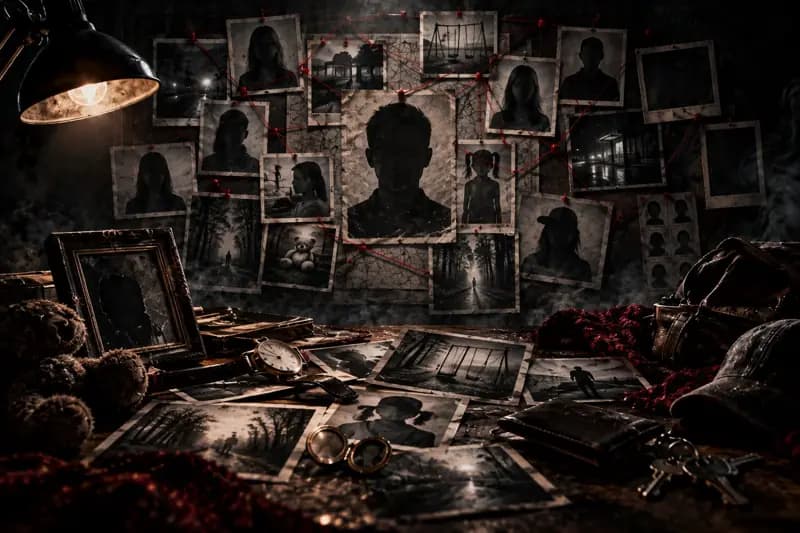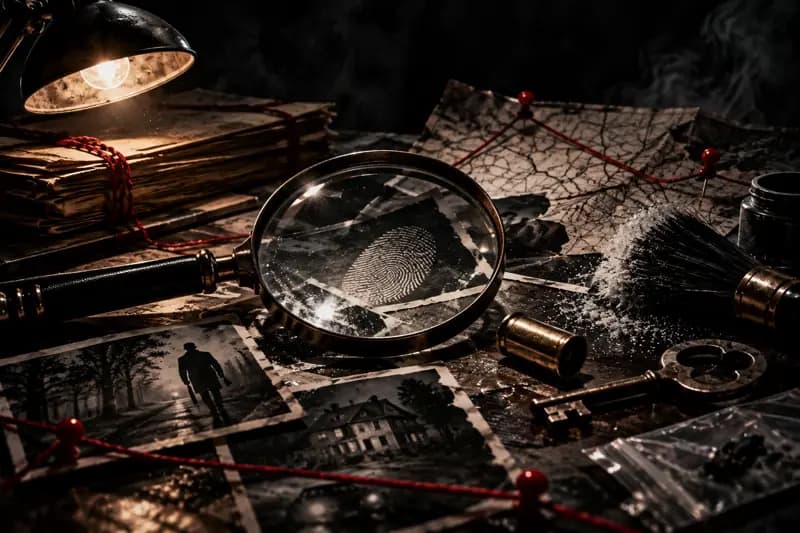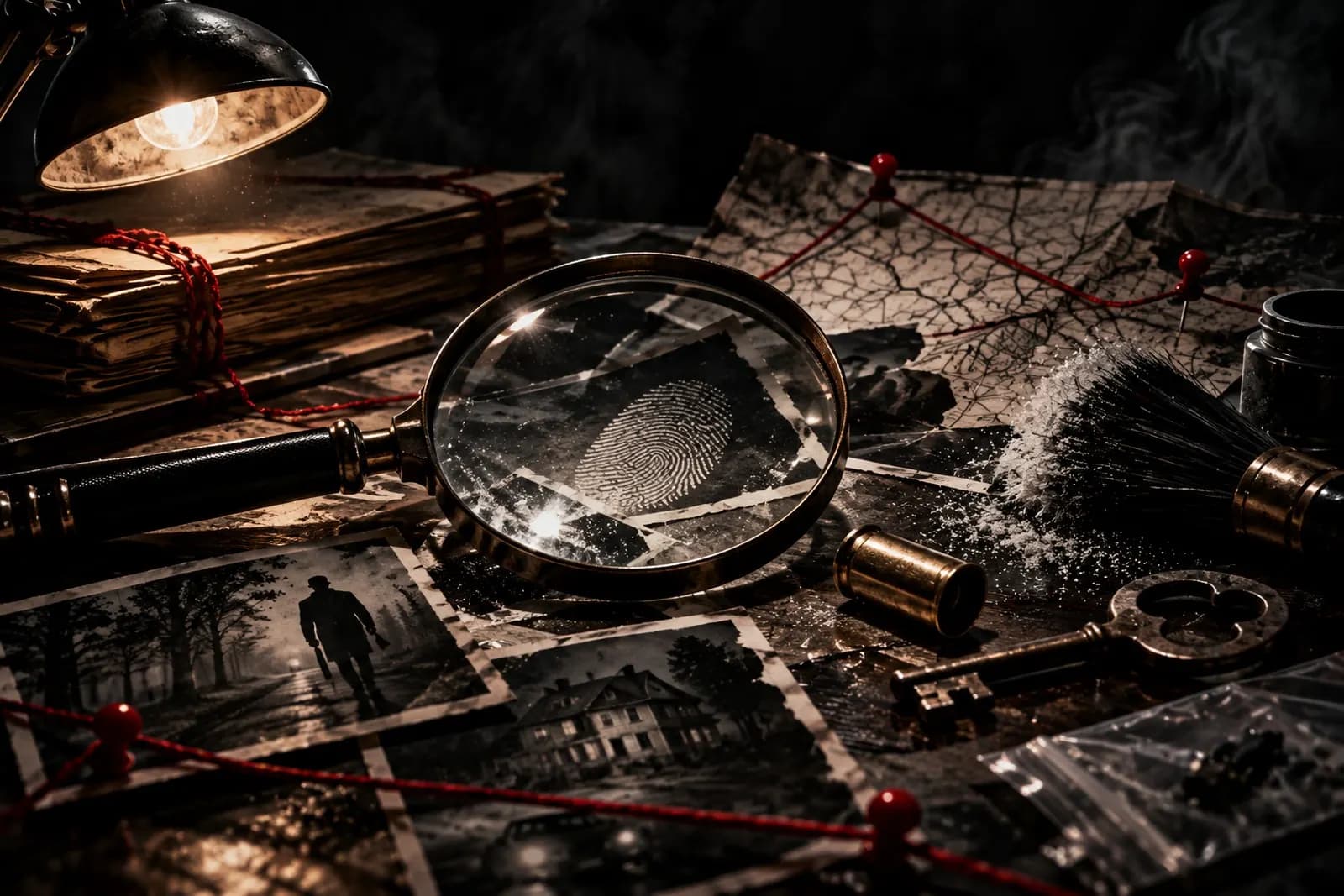
If you have ever paused a true crime podcast to look at a map of a highway, a desk covered in folders or a close-up of a fingerprint, you already understand the appeal of true crime coloring pages. They take the quiet, absorbing mood of an investigation and turn it into something your hands can do.
This guide explains what true crime coloring pages are, what makes a good one, and how to get the most out of them, on paper or on a phone.
What are true crime coloring pages?
True crime coloring pages are black-and-white line drawings built around the world of criminal investigation. Instead of gardens and mandalas, the subjects are the things that fill an investigator's working day:
- Evidence and clues: fingerprint cards, evidence tags, sealed envelopes, magnifying glasses.
- Scenes and settings: cordoned streets, empty rooms, roadside motels, neon vacancy signs.
- Investigation tools: detective desks, notebooks, tape recorders, one-way glass.
- Archives: newspaper clippings, contact sheets, case folders and maps with pins in them.
- Famous investigations: landmark cases retold as illustration, not as spectacle.
The best pages are illustrative and atmospheric rather than graphic. The point is the mood of the file on the desk, not the violence of the crime.
Why adults enjoy them
People come to the hobby from two directions. Some are coloring fans who find floral designs too sweet. Others are true crime fans who want something calm to do while they listen to a podcast or watch a documentary.
A few reasons it works:
- It gives your hands something to do. Listening to a long episode is easier to enjoy when you are not also scrolling.
- It is slow on purpose. There is no score and no deadline. A page takes as long as it takes.
- The subject is already familiar. If you like the atmosphere of case files, the imagery feels like a natural fit.
- Color changes the tone. The same scene can look vintage and sepia, cold and blue, or bold and strange, depending on your choices.
Many people describe coloring as relaxing or absorbing. Research on its effects is limited and the results are mixed, so it is best thought of as an enjoyable, low-pressure pastime rather than a treatment for anything.
What makes a good true crime coloring page
Not every drawing is worth coloring. When you are choosing a book or an app, look for these qualities:
Clean, confident line work
Lines should be clear and closed, so you know where each shape begins and ends. Messy or broken outlines make coloring frustrating, especially on a screen where you tap to fill.
A range of detail
A good collection mixes pages with large, calm areas and pages with fine detail such as hatching, text on documents and small objects. That way you can pick a page to match your energy: a quick one for a short break, an intricate one for a long evening.
A consistent atmosphere
The strongest collections feel like they belong together. Shared lighting, framing and subjects give the whole set a single mood, so a folder of cold case files feels different from a series of crime scenes.
Respect for real people
Pages inspired by real investigations should focus on evidence, places and procedure, not on glorifying anyone who committed a crime. That tone is a good test of whether a collection was made with care.
Paper or app?
Both are good, and the choice is mostly about how you like to relax.
| Paper books | Coloring apps | |
|---|---|---|
| Feel | Pencils or markers on paper | Tap to fill, pinch to zoom |
| Color range | Limited to what you own | Palettes ready to use |
| Mistakes | Permanent | Undo and redo |
| Portability | Bulky | Always on your phone or tablet |
| Fine detail | Needs a sharp pencil | Zoom into small areas |
| Sharing | Photograph the page | Export the finished image |
An app is especially handy for dense pages, since you can zoom in on a single document or evidence tag and fill it without leaving the lines.
How to start: a simple routine
You do not need any experience. Here is an easy way to begin.
- Pick one collection. Choose a theme you enjoy, such as evidence and clues or detective desks, and stay with it for a few pages so you get a feel for its style.
- Start with a simple page. Choose an image with large areas first, then move on to finer detail.
- Choose a palette before you begin. Picking three or four main colors up front keeps the page looking intentional.
- Work from large areas to small. Fill big shapes first, then add details such as labels, lamps and small objects.
- Zoom in for the fine parts. On a phone or tablet, pinch to zoom before filling small areas.
- Stop when it feels done. There is no right answer. Finished is whenever you say it is.
Choosing colors for a true crime scene
Color is where you decide how the story looks. A few directions to try:
- Vintage and muted: warm browns, faded reds, old-paper cream. This is the classic archive-photograph look.
- Neutral and cool: greys, steel blues and soft greens for a quiet, forensic feel.
- Rich and bold: deep crimson, brass and teal for a dramatic, noir poster feeling.
A useful trick is to keep most of the page in two or three muted colors and use one strong accent, such as a single red object, to draw the eye.
Using the True Crime Coloring Book app
True Crime Coloring Book is an adult coloring app for iPhone and iPad built around exactly this idea. Every page begins in black and white, like an archive photograph, and you decide what it becomes.
- Ten collections of detailed line art: infamous investigations, cold case files, crime scenes, evidence and clues, detective investigation, interrogation rooms, dark roads and motels, missing persons, unsolved mysteries and a newspaper archive.
- Tap to fill, with pinch to zoom for fine detail.
- Three curated palettes: Vintage, Neutral and Rich, with muted tones chosen to suit the subject matter.
- Undo and redo, so you can change your mind as often as an investigation does.
- Progress saved automatically on your device, so every file is where you left it.
- Export your finished page as an image or save it to your photo library.
- Optional dark ambient score, with a switch for when you would rather have silence.
- Works offline, with no account needed to open a case and start coloring.
You can see the app in action in the coloring experience section on the home page.
Frequently asked questions
Do I need to be good at art?
No. The line work is already drawn. Your job is choosing colors and deciding how the page feels, which is a different skill from drawing.
Are the pages graphic or disturbing?
The artwork is illustrative and atmospheric rather than graphic. It focuses on desks, evidence, places and documents rather than on violence.
How long does a page take?
It depends on the page. A simple one can be filled in a short break, while an intricate one with hatching and small objects can fill an entire evening.
Can I do this while listening to a podcast?
That is how many people use it. Coloring keeps your hands busy while you follow the story, and the pace is easy to match to the episode.
Is it only for true crime fans?
No. The subjects are crime-themed, but the appeal is the mood: archives, noir lighting and quiet detail. If you like mystery novels, old films or vintage photography, you will probably feel at home.