"You have the right to remain silent." Millions of people who have never been arrested can recite the next line from memory, because police shows have repeated it for decades. Few viewers know where the words came from. They are not an old tradition or a line in the Constitution. They come from a single Supreme Court decision, handed down on June 13, 1966.
This article explains what happened in the case behind the warning, what the Court actually decided, what the warning does and does not do, and how the ruling has been treated since. It describes U.S. law in general terms and is not legal advice.
Before Miranda: the "third degree"
For much of American history, there was no constitutional requirement to warn suspects of their rights. Suspects were questioned in police stations, often alone and cut off from family and lawyers. The decision itself describes how, in the early 1930s, a presidential commission known as the Wickersham Commission documented police violence and the "third degree," meaning physical or psychological pressure used to extract confessions. The Court noted that its own earlier cases had involved beatings, hangings and whippings.
Courts did throw out confessions that were obtained by force, but they judged each case separately, asking whether the statement was voluntary under the circumstances. That test was hard to apply, because what happened in an interrogation room was usually known only to the people inside it.
The law began to shift in the early 1960s. In 1964, in Escobedo v. Illinois, the Supreme Court dealt with a suspect who was questioned for four hours at a police station, handcuffed, after police refused his request to speak to his lawyer and kept his lawyer from seeing him. The Court overturned the conviction. The question left open was how far that principle reached. Two years later, four cases that came to the Court together, including Miranda's, gave it the chance to answer.
The case: Phoenix, 1963
The best-known of those cases involved Ernesto Miranda. The following facts come from the Court's own account of the case.
On March 13, 1963, police arrested Miranda, a 23-year-old, at his home and took him to a Phoenix police station. A witness who had reported a serious crime identified him there. Officers then took him to "Interrogation Room No. 2," where two officers questioned him. At trial the officers admitted that they had not told Miranda he had a right to have an attorney present.
Two hours later the officers came out with a written confession signed by Miranda. At the top of the page was a typed paragraph stating that he made it voluntarily and "with full knowledge of my legal rights." Miranda was convicted of kidnapping and rape and sentenced to 20 to 30 years on each count, to run at the same time. The Arizona Supreme Court upheld the conviction, noting that Miranda had never specifically asked for a lawyer.
The case matters in legal history because of the question it raised: can a confession be used against someone who was never told that they did not have to give it? The victim is not named here, as in the Court's opinion. The ruling was about police procedure, not about whether the crime happened.
The decision: Miranda v. Arizona (1966)
The Supreme Court heard arguments over three days, from February 28 to March 2, 1966, and decided the case on June 13. The vote was 5 to 4. Chief Justice Earl Warren wrote the opinion for a majority that also included Justices Black, Douglas, Brennan and Fortas. Justices Harlan, Stewart and White dissented, and Justice Clark agreed in part and dissented in part.
The Court decided that the Fifth Amendment protection against being forced to incriminate yourself applies to questioning in police custody. Because custodial interrogation is isolating and pressured by its nature, the Court said, something more than a case-by-case voluntariness test was needed. The majority wrote that the prosecution may not use statements from custodial interrogation unless it shows that it used procedural safeguards "effective to secure the privilege against self-incrimination."
Unless police use some other fully effective means, the Court said, a person must be warned before any questioning:
- that they have the right to remain silent;
- that anything they say can be used against them in a court of law;
- that they have the right to the presence of an attorney; and
- that if they cannot afford an attorney, one will be appointed for them before questioning, if they wish.
After the warnings, a person may waive these rights, but the prosecution bears a "heavy burden" to show that the waiver was knowing and intelligent. The opinion adds that a waiver cannot be presumed from silence alone.
The Court also reversed Miranda's conviction in his case, because he had not been properly advised.
The dissents
The dissenting justices argued that the decision was unwise and went beyond what the Constitution required. Justice Harlan wrote that the Court had created a new "constitutional code of rules for confessions." Justice White warned that the new rule would operate in every case, "regardless of the severity of the crime" and could slow down investigations. These arguments were not settled in 1966, and some of them have returned in later cases.
What happened to Ernesto Miranda
The Supreme Court's ruling did not free him. Arizona tried Miranda again, this time without the confession. According to published accounts, he was convicted again in 1967, based on testimony from his former partner that he had admitted the crime to her. He was paroled in 1972. On January 31, 1976, Miranda was stabbed to death in a fight at a Phoenix bar. He was 34. A suspect was charged but fled to Mexico and, according to published accounts, was never brought to trial.
The details of his later life come from secondary sources, which are listed below, and are included here only to complete the story. The ruling that bears his name is the part of this history that shaped law enforcement across the country.
What the warning does, and what it doesn't
Miranda is often misunderstood, partly because of television. Here is what the decision and later cases establish.
- It applies to custodial interrogation. The Court defined this as questioning by law enforcement after a person has been taken into custody or otherwise deprived of freedom in a significant way. A person who is not in custody, or who is not being questioned, is not covered in the same way.
- It is not a requirement to read the words at an arrest. Police are not required to recite the warning at the moment of arrest. They must give it before questioning someone in custody if they want to use the answers in court.
- The consequence is about evidence. If police skip the warning, the usual consequence is that the statement may not be used by the prosecution. The case is not automatically dismissed, and other evidence may still be used.
- There are exceptions. For example, in New York v. Quarles (1984) the Court allowed an exception when questions are asked to deal with an immediate threat to public safety.
- Invoking your rights must be clear. In Berghuis v. Thompkins (2010), a suspect had been mostly silent during a three-hour interrogation and then answered one question. The Court held that he had not invoked his right to remain silent, because a suspect must do so unambiguously, and that by answering he had waived it. The decision was 5 to 4.
Has Miranda been overturned?
No. Two Supreme Court decisions are worth knowing.
Dickerson v. United States (2000). Two years after Miranda, Congress passed a law saying that a confession should be admissible in federal court if it was voluntary, whether or not warnings were given. In 2000, the Court ruled 7 to 2 that Miranda is a constitutional decision, so Congress cannot overrule it by statute. Chief Justice Rehnquist wrote that Miranda had become "embedded in routine police practice to the point where the warnings have become part of our national culture."
Vega v. Tekoh (2022). A man whose statement had been taken without warnings, and who was later acquitted, sued the deputy who questioned him. The Court held that a violation of Miranda does not by itself give a basis for a civil rights lawsuit against the officer. It described the Miranda rules as "prophylactic," protective rules that guard the constitutional right, and pointed to the suppression of the statement at trial as the protection that serves their purpose.
A note on other countries
Everything above is about the United States. Other countries have their own rules about what suspects must be told and what happens if police get it wrong, so it is not safe to assume that U.S. rules apply elsewhere. If you are questioned by police, the right step is to ask a lawyer about the law where you are.
Myths and facts
| Myth | Fact |
|---|---|
| Police must read the warning at every arrest. | The warning is required before custodial questioning, not at the moment of arrest. |
| If police forget the warning, the case is dismissed. | The usual result is that the statement cannot be used by the prosecution; other evidence can still count. |
| The words come from the Constitution. | The wording comes from the 1966 Supreme Court decision, which is based on the Fifth Amendment. |
| Staying silent during questioning is the same as invoking the right to remain silent. | In Berghuis v. Thompkins the Court held that a suspect must clearly say they are invoking the right. |
| Miranda was set free by the Supreme Court. | His confession was thrown out, but he was tried again and convicted. |
Frequently asked questions
Who was Miranda?
Ernesto Miranda was a man arrested in Phoenix in 1963 whose confession, taken without a warning of his rights, led to the 1966 Supreme Court decision that carries his name.
Do police have to say the exact words?
The Court described what the warnings must tell a person rather than prescribing exact wording. Many agencies use printed cards or forms so that officers cover each element.
Does Miranda apply if I'm not under arrest?
The warnings apply to custodial interrogation, which the Court defined as questioning after someone has been taken into custody or deprived of freedom in a significant way. Whether a situation counts as custody depends on the facts.
Can the warning be waived?
Yes. A person may knowingly and voluntarily waive the rights and agree to talk, but the prosecution must be able to show that the waiver was valid.
Where the app fits in
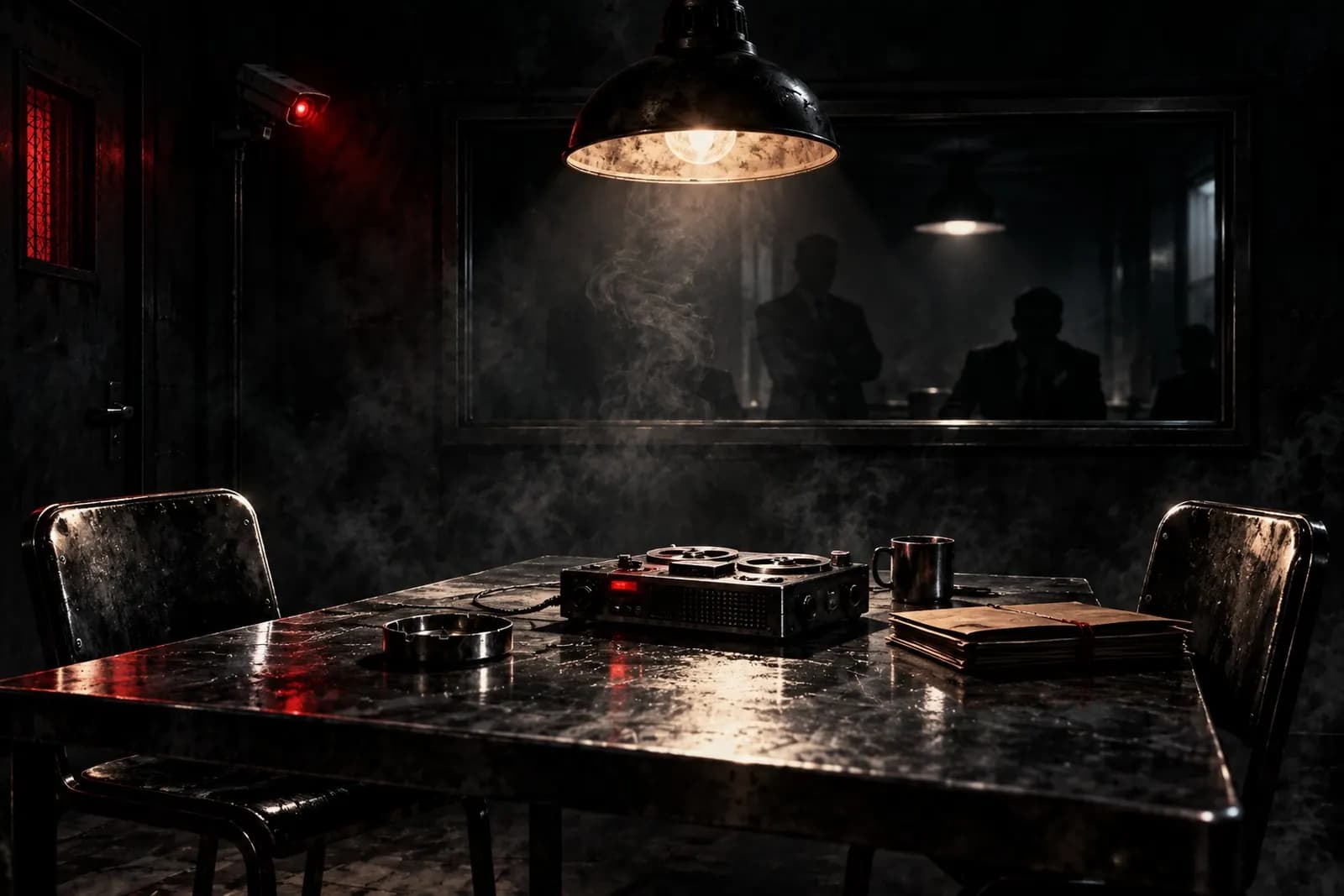
If the atmosphere of the interview room is what interests you, the Interrogation Rooms collection in the True Crime Coloring Book app is built around it: steel tables, reel-to-reel recorders and one-way glass, drawn as line art for you to color. The artwork is illustrative rather than graphic.
Sources
- U.S. Supreme Court, Miranda v. Arizona, 384 U.S. 436 (1966), via Cornell Legal Information Institute: facts of the case, the holding and the four warnings, the vote and the dissents.
- U.S. Supreme Court, Dickerson v. United States, 530 U.S. 428 (2000).
- U.S. Supreme Court, Berghuis v. Thompkins, No. 08-1470 (2010).
- U.S. Supreme Court, Vega v. Tekoh, No. 21-499 (2022), which also summarizes New York v. Quarles (1984).
- National Constitution Center, Miranda v. Arizona, for the list of the majority and dissenting justices.
- Ernesto Miranda, Wikipedia, for the retrial, parole and death of Ernesto Miranda; it cites newspaper reports from the time, which we have not read directly.